
Author Archives: Cherylanne Skolnicki

Talkin’ ‘Bout a Revolution


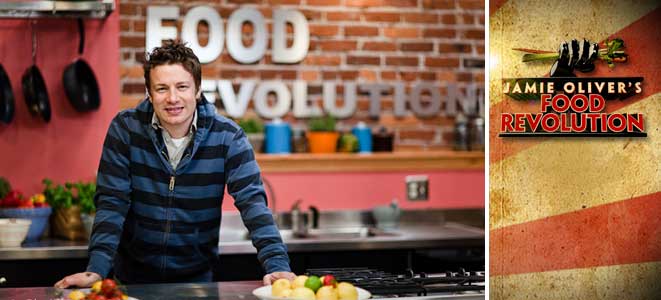
While I have always liked the Tracy Chapman song Talkin’ ‘Bout a Revolution…it’s not the reason for this particular post. Instead, I’m inspired by what superstar chef Jamie Oliver (of Naked Chef fame) is up to with his new show “Jamie Oliver’s Food Revolution.” Airing on ABC on Friday nights at 9PM EDT, I caught up on the first episode via DVR last night. And I have to say that I was simultaneously impressed with his incredible chutzpah and appalled by the reception he got from the very people he was trying to help. His philosophy is so sane and so balanced that it’s hard to imagine anyone ARGUING with him…but argue they did. It reminded me that food is personal and when someone threatens established habits of an entire city as he does in his show (set in Huntington, WV – deemed the unhealthiest city in America by the Center for Disease Control) it can get a little ugly!

In the show, Jamie focuses on improving school food and on teaching people to cook from fresh, whole ingredients. He doesn’t completely eschew sweets or treats, but views them as occasional indulgences, not as everyday fare. There’s an incredible scene where he dumps out all the food one family eats in a week on the kitchen table and everything…I mean everything…is “golden brown”. Not a color to be seen. This is how America eats??

Here is the philosophy Jamie outlines on his website…see what you think.

“My philosophy to food and healthy eating has always been about enjoying everything in a balanced, and sane way. Food is one of life’s greatest joys yet we’ve reached this really sad point where we’re turning food into the enemy, and something to be afraid of. I believe that when you use good ingredients to make pasta dishes, salads, stews, burgers, grilled vegetables, fruit salads, and even outrageous cakes, they all have a place in our diets. We just need to rediscover our common sense: if you want to curl up and eat macaroni and cheese every once in a while – that’s alright! Just have a sensible portion next to a fresh salad, and don’t eat a big old helping of chocolate cake afterwards.

Knowing how to cook means you’ll be able to turn all sorts of fresh ingredients into meals when they’re in season, at their best, and cheapest! Cooking this way will always be cheaper than buying processed food, not to mention better for you. And because you’ll be cooking a variety of lovely things, you’ll naturally start to find a sensible balance. Some days you’ll feel like making something light, and fresh, other days you’ll want something warming and hearty. If you’ve got to snack between meals, try to go for something healthy rather than loading up on chocolate or potato crisps. Basically, as long as we all recognize that treats should be treats, not a daily occurrence, we’ll be in a good place. So when I talk about having a ‘healthy’ approach to food, and eating better I’m talking about achieving that sense of balance: lots of the good stuff, loads of variety, and the odd indulgence every now and then.”

I suppose it’s easy for me to view his philosophy as balanced when it lines up so well with my own! I’d love to hear other points of view on his philosophy, the Food Revolution he is trying to start, or the show in general….check out his siteor the show…and tell me what you think by commenting here.

Caffeine – pleasure or poison?


One topic that almost always comes up in my early talks with a new client is caffeine. It isn’t usually the first thing on their mind as it relates to their health but eventually they wonder aloud if they are consuming too much…and if so, what effects it might be having on their body and their life.

I’ll leave the full discourse on caffeine’s bodily effects to medical doctors, but I do have a point of view on how it can jeopardize our ability to achieve a healthy lifestyle with balanced energy throughout the day.

The biggest challenge caffeine presents is that it creates what I call “Fake Energy”. It essentially tricks the body into THINKING it has energy when in fact, just the opposite is true!

Consider a fictitious person who stays up late at night working or watching TV or suffering from insomnia and consequently wakes up in the morning feeling a little sleepy. She’ll say that while she is not hungry in the morning, she simply can’t leave the house without that first cup of coffee or tea (or two). She can then “go for hours without eating” simply refilling her cup of caffeine periodically throughout the morning. She may grab lunch and then find she hit a mid-afternoon lull which she gets through with….an afternoon Starbucks run! Then she wonders aloud why she is always the so wide awake in the evening, even to the point of having difficulty falling asleep at night.

If I deconstruct this pattern, it becomes clear that while the person above is tricking her body into thinking it has energy, in reality the things that TRULY provide energy are being withheld — namely, nourishing food and adequate rest.

A healthier pattern might look like:
1- Getting 7-8 hours of sleep
2- Starting the day with a balanced breakfast
(protein, high fiber carbohydrate, fruit or vegetable)
3- Getting some exercise
4- Eating every 3-4 hours throughout the day
(to maintain stable blood sugar and energy levels)
5- Sufficiently hydrating throughout the day with caffeine-free beverages

But caffeine so thoroughly masks the natural desire for this pattern that a person can completely disconnect from it and instead survive (but importantly not thrive!) on mug after mug of good ol’ “Fake Energy”.

So let’s say you recognize yourself in the scenario above…what exactly should you do? Start by reducing the post-lunch caffeine you consume until you can get to sleep at an hour that gives you 7 or 8 solid hours of sleep. Then, eat something within an hour of waking up…whether or not you feel hungry. You may need to retrain your body to accept food in the morning but over time you will reclaim a healthy, natural rhythm for hunger that is not masked by caffeine. Then pick up the recommended pattern above to derive energy from REAL sources. If I can support you in this journey, please reach out to me! Together we can kick the Fake Energy habit and get you on a path to a life full of the energy you deserve.

I have to end by saying that for many of us (myself included!) morning coffee provides a delightful ritual of warmth and comfort. There’s nothing quite like holding a favorite mug steaming with aromatic goodness to start your day…and there is no reason to give this up! You can gradually convert to decaffeinated coffee, preserving all the joy and pleasure of the ritual, or even keep that one cup a day of caffeinated coffee with little ill effect. The key is simply to ensure that you are not using caffeine as a substitute for real nourishment that provides energy to fuel your life!

What do good knives have to do with good health?


It may seem that knives have absolutely nothing to do with health, yet good kitchen knives are the first kitchen tool in which I encourage clients to invest if they haven’t done so already. For less than $300, a home cook can get the essential knives needed for daily meal preparation and over time, can probably save more than that in headache remedies for the pain and suffering caused by dull knives! (If you’re wondering what the second purchase I recommend is, it’s a good cutting board, of course!)

My premise is that most healthful meals involve SOME sort of trimming, chopping, dicing, and slicing and if you are attempting this with dull or cheap knives, there are numerous challenges. Upgrading to a decent set of knives has a host of benefits, but here are my Top 3.

1) Speed
Good, sharp knives are faster. Plain and simple. Slicing a tomato with a dull, low quality knife is an exercise in Zen-like patience as you saw back and forth hoping to eventually break through the tomato skin (Seriously? HOPE to break through? We’re talking about a TOMATO SKIN here and I’ve had this experience more than once when cutting a tomato with a sub-par knife! Sheesh.) If you’ve never used quality knives, you will be AMAZED by how much more quickly you are able to complete the preparation for any recipe.

2) Results
Quality knives just do a better job at cutting! They cause less (aesthetic) damage to the food when it’s being prepared, leaving you with more beautiful slices or dices on the plate. And when you’re dealing with healthy food, presentation matters even more. Since they don’t mangle the tomato or bread or whatever it is you are trying to cut, there is also less waste.

3) Safety
Paradoxically, you are actually LESS likely to cut yourself with a SHARP knife than with a DULL one! And since good knives are often sold in knife blocks, you’ll keep your fingers
(and any little fingers that roam your kitchen drawers) from being accidentally cut when digging for a knife.

So you’re ready to buy? There are really three basic knives that should be in your collection.

Once you get comfortable with what these three can do, you can go crazy adding many more specialized tools to your knife block, but these three could easily last most home cooks a lifetime. Here’s a bit about when to pull out each one.

A 7-10″ Chef’s Knife – this is your basic kitchen workhorse. It makes me crazy when I see someone using a teensy paring knife to chop a potato or carrot or celery into her hand! A cutting board and a chef’s knife make quick work of most chopping and dicing. This knife will also slice meat (ham, turkey, beef, etc) beautifully.

A 3-4″ Paring Knife – This is your “precision” knife – great for peeling vegetables or fruits but also for deboning meats.

A Serrated bread knife – You need to use a sawing motion when using a serrated knife vs just pushing the knife straight through the food to be cut. The serrated edge thereby slices bread without mangling it, but it’s also super for tomatoes which can tend to crush under the weight of a less-than-perfectly-sharp chef’s knife.

Which brings me to one important disclaimer:
A good knife only stays good if it stays sharp! Once you’ve invested in knives, you must commit the time to keeping them sharp. Even the very best quality knife will dull over time with use. Did you know professional chefs sharpen their knives every DAY? You can do this at home by using a honing steel to prevent or delay dulling by honing before each use, but a steel will not make a dull knife sharp again! As a result, you should also buy a good quality knife sharpener OR have your knives professionally sharpened periodically (once or twice a year). Trust me, you will notice and appreciate the difference when you do!

There are countless brands of quality knives out there. I swear by Wusthof because I grew up with them and have owned them personally for the last 15 years. J.A. Henckels is an other excellent brand and I often hear good things about Japanese brands like Shun and Global as well. The most important thing is to go to a store and actually HOLD the knife before buying. You’ll want one that feels right in your hand. Not too big or too small, too heavy or too light. You’ll know it when you find it. And then you’re off and chopping!