 Remember learning about the food pyramid in school? You remember, the one depicting the food groups and recommended servings of each one? Can you name the food groups YOU learned in school? Well, in the words of Bob Dylan, the times they are a-changin’!
This year, the USDA and FDA will jointly release the 2010 Dietary Guidelines for Americans. The current guidelines came out in 2005 and will remain in effect until these are released. Last week, a preview of the report from the Advisory Committee was released for public comment. I took some time to review the Executive Summary and some of the more detailed findings to see what we have in store for us when the new guidelines are released later this year.
The Dietary Guidelines contain the latest, science-based nutritional and dietary guidance for the general public. They are the foundation for federal nutrition education and promotion programs, as well as the basis for the federal food assistance programs, so they are pretty important!
Here is some of what I discovered it’s likely we’ll see in the 2010 revisions:
– A shift to a more plant-based diet recommendation, emphasizing vegetables, cooked dry beans and peas, fruits, fiber rich whole grains, nuts and seeds
– A recommendation to increase the intake of seafood and nonfat/low fat milk products
– A recommendation to consume only moderate amounts of lean meats, poultry and eggs
– Guidance to significantly reduce intake of foods containing added sugars, solid fats, sodium, and refined grains
– Guidance to replace energy-dense foods with nutrient-dense foods (love this!)
– A recommended alcohol consumption maximum for adults of 1-2 beverages a day
Beyond that, there are some changes recommended to the “food environment” (aka the world in which we operate as Americans). These may include efforts to:
– Improve nutrition literacy and cooking skills so people prepare and consume more food at home (YAY!!!)
– Increase health, nutrition, and phys ed programs in schools and preschools
– Create greater financial incentives (especially for low-income Americans) to purchase, prepare and consume the healthiest foods
– Encourage restaurants to offer health-promoting foods
While I think all of these findings and likely outcomes represent steps in the right direction, it’s unlikely we’ll see MAJOR shifts within the pyramid since both the FDA and USDA are so heavily influenced by the food industry and agricultural lobbyists in America, who have a vested interest in protecting the historical recommendations which leaned heavily on American-produced crops and animal products.
What seems to me to be important is figuring out your OWN food pyramid – one that works for you and makes you feel your best.
As one to consider, I really like Dr. Andrew Weil’s Food Pyramid and it’s recommendations – in fact, I think this is how I’ve largely been eating and feeding my family over the last few years (minus the unlimited cooked Asian mushrooms – not that I’m opposed to them!). His recommendations just make sense to me and when i’m eating in accordance with them, I know I feel my best. No one approach to eating works for everyone, but this is one (rooted in the Mediterranean Diet) that sure seems to work for a lot of people! Check it out…experiment with your food…and of course, stay tuned for the release of the new 2010 Food Pyramid later this year – I’ll be anxious to see how much change we can get onto that page!

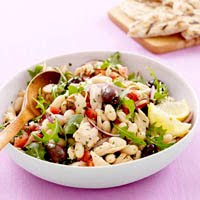 This is a delightful discovery from delish.com that I tried for the first time a few weeks ago. It’s a cold salad with a great balance of flavors and textures, packed with 31 g of protein and only 3 g of saturated fat per serving. Better still, you can make it in about 10 minutes and be eating before you know it which makes it perfect for a weeknight dinner or a fast lunch. Sometimes cooking is really nothing more than assembling a few quality ingredients, and this is clearly one of those times!