
Category Archives: Food

Keeping Herbs Within Arm’s Reach


If you get the Nourish newsletter, you know that I’ve resolved to replant my herb garden this month. If you don’t receive the newsletter and would like to, you can sign up here!

As background, I started a “potted garden” on the steps to our back patio several years ago and while I’m sure better gardeners can keep their plants alive from year to year, I simply pack it up in mid-November, dump the barren pots, and wait for spring until I can replant! And so it’s time for Herb Extravaganza 2010.

Planting herbs in pots outside is SUPER easy. And thank goodness it is, because I can assure you that despite both of us having descended from farming ancestry, neither my husband nor I has a particularly green thumb. We’re trying to get the grandparents to teach our children how to REALLY garden and it seems to be working. Case in point? Our 5 year old is sprouting beans in a Ziplock baggie as I write this, though I admit that was a project started in her preschool classroom. Both sets of grandparents plant significant backyard gardens each year and let the kids take part in planning, planting, weeding, watering, and harvesting. I am so grateful for this AND for the bounty of produce that comes our way each summer. Is there anything better than a home-grown tomato? Seriously.

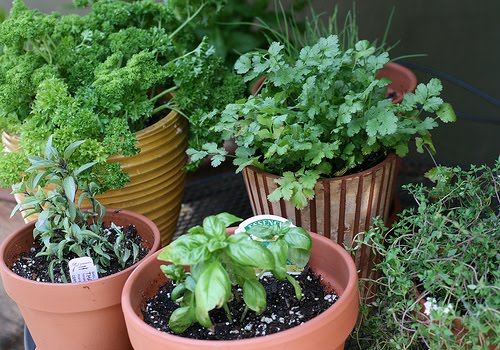
But I digress. This post is about herbs. My ode to vegetable gardens (and the in-season tomato!) will have to wait for another post. Herbs, herbs, herbs. Planting and maintaining herbs just feels simpler to me than vegetable gardening. I normally plant 8-10 pots of herbs and keep them within arm’s reach of the back door, which makes dinnertime use a breeze.

Most of the herb varieties I plant require the same growing conditions, which makes maintenance even easier:

  1. Full Sun – Lucky for me, our back patio BAKES in sun.
  2. Plenty of water, with good drainage – Preschoolers adore watering cans! And using pots with holes drilled in the bottom ensures good drainage.
  3. Slightly “lean” soil and infrequent fertilizing – How great that this low maintenance combination makes the herbs’ oils even more potent!
  4. Periodic trimming and harvesting – A no-brainer – I grow them to USE them, not to look at them.

This year I’m planting the following:

  1. Basil – We love this on caprese, that classic tomato and fresh mozzarella salad that is ubiquitous in the summer when tomatoes are in season. I also love to make my own pesto so I grow lots and lots of basil as you need bunches of it for that.
  2. Chives – Chopped, these are fabulous on potatoes and in some fish dishes.
  3. Cilantro – I use this in my guacamole, salsa, and a host of summer salads. You’ll recognize it as the quintessential Mexican cooking herb.
  4. Mint – I make homemade lemonade or iced tea and garnish with fresh mint. Mojitos, too! And it’s a great garnish on fruit desserts.
  5. Oregano – I love this on a traditional Greek Salad of tomatoes, cucumbers, red onion and feta, drizzled with a great fruity olive oil. It’s also excellent in pasta sauce, on fish and in many Italian dishes.
  6. Parsley – This is such a versatile herb. I adore it chopped liberally on top of boiled new potatoes that are drizzled with browned butter and sprinkled with sea salt. It makes its way into a lot of my salads and sautes..it seems to add a note of freshness to anything it touches.
  7. Rosemary – Pork tenderloin, chicken, tilapia, salmon…they all get a sprinkle or a sprig of rosemary before making their way to the grill. In the fall and winter, I love this on roasted root vegetables and in the summer, it goes into our grilled vegetable concoctions.
  8. Thyme – This is my favorite herb! It goes in virtually every salad dressing I make and I often add it to vegetable, pasta or fish dishes as well.

If eight varieties feels like too many, I encourage you to experiment with planting even one or two pots of herbs of your own this spring. You can find seedlings at your farmer’s market, garden center, the grocery store, Home Depot, Lowe’s, and many other places. Using seedlings is faster than starting from seeds and you’ll get a better sense of how much room each plant will require. Then buy some decent sized pots (10-12″ across) with drainage holes, a bag of potting soil, and get yourself started!

Did you know that cooking with fresh herbs (in addition to salt, shallots and butter) is a big restaurant secret behind those flavors you find difficult to reproduce at home? Having your own collection of herbs within arm’s reach will spark your culinary creativity throughout the summer. Let me know how it goes!
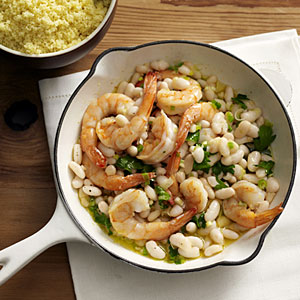
Shrimp with White Beans and Asparagus

THIS is what you should make for dinner this weekend! (If I do say so myself.) I ripped this recipe out of Health magazine a while back and have been passing over it in my recipe file for far too long. It finally made the cut this week…and WOW…I’m so glad it did! My kids scarfed it down, my husband raved about it, and I’m already planning for the next time I can make it. Yum. As if that endorsement weren’t enough, this takes 10 minutes of prep time and cooks in about 5 minutes. Amazing.

I made some adaptations to the original recipe which I’ve included in the version below. I added asparagus because I thought it needed more vegetables and asparagus is perfectly in season right now! I also decided to serve it over Israeli Couscous, which is the larger couscous that looks like little tapioca balls. I like the texture better than the super fine couscous you generally see in stores. You can find Israeli Couscous in the bulk foods aisle of Whole Foods or other grocery stores, or sometimes in a box near the rice in most grocery stores. If you can’t find it, don’t sweat it. I’m sure traditional couscous would work just fine! In case couscous is new to you, it’s basically just a tiny shape of semolina pasta, not a grain unto itself.

Shrimp with White Beans and Asparagus over Israeli Cous Cous
adapted from Health Magazine recipe

serves 4

1 10 oz. box (1.5 cups bulk) Israeli Cous Cous, cooked according to package instructions
1 lb. asparagus, cut into 1″ pieces, blanched (see below for instructions)
1 Tbsp. olive oil
2 Tbsp. butter, divided
2 garlic cloves, chopped
8 scallions, chopped (about 1 bunch)
1 lb. medium shrimp, raw, peeled and deveined
1 (15.5 oz) can cannellini beans, drained and rinsed
1/2 cup fresh parsley, chopped
2 Tbsp. fresh lemon juice
1 tsp. kosher salt
1/2 tsp. pepper

Cook couscous and set aside.

Heat 1 Tbsp. olive oil and 1 Tbsp. butter in large skillet over medium-high heat. Add garlic and scallions; cook 30 seconds.

Add shrimp and cook, stirring, 3 minutes or until they begin to turn pink.

Add asparagus, beans, parsley, lemon juice, remaining 1 Tbsp. butter, salt and pepper. Cook 2-3 minutes or until heated through. Taste and adjust seasoning as desired.

Serve over couscous.

How to blanch asparagus:
Wash and cut the asparagus into 1″ pieces. Place in a microwave safe bowl with 2 Tbsp water. Cover with plastic wrap. Microwave for 2 minutes on high. Immediately transfer asparagus pieces to a bowl of ice water to stop the cooking. After 2 minutes, remove cooled, blanched asparagus from ice water and set aside until ready to use.


Fiber-licious


I’m told I spend a ridiculous amount of time extolling the virtues of fiber. My clients are probably sick of hearing me go on and on about how to squeeze more fiber into their daily dining plans. But, the truth is, fiber is so critical to a healthful diet that I can’t help myself from evangelizing its benefits!

What is fiber anyhow?
Fiber is basically the part of carbohydrates (fruits, vegetables, and grains) that cannot be digested. Fiber is only found in plant-based foods, never in animal-based foods. Most of us need 25-35 grams of fiber a day for optimum health, but most Americans get fewer than 15 grams a day. The best sources of fiber are things like:

  • Whole grains (in breads, cereals, or on their own)
  • Nuts and Seeds
  • Beans and other legumes
  • Fruits and vegetables

So what’s so great about fiber?

1) Fiber helps to fill you up and create a feeling known as “satiety”- a.k.a. a happy belly!
If you only know one thing about fiber this is probably it! Fiber is Filling with a capital “F”. The difference between a 200 calorie bowl of cereal with 12 grams of fiber and a 200 calorie bowl with 0 grams is unbelievable both in terms of how satisfied you’ll feel after eating it and how long you will stay satisfied.

2) Fiber eases constipation and promotes regularity.
Did you know that constipation is America’s most common digestive complaint? And in nearly all cases, it is treatable by increasing the intake of fiber. Since our processed-food-dependent American diet has had nearly all of the fiber stripped out of it, constipation has crept into the lives of many unsuspecting consumers.

3) Fiber can help to prevent a number of diseases, like heart disease, certain cancers, and diabetes.
‘Nuff said.

4) When you eat more fiber, you instinctively eat LESS overall!
There’s data to back this up, folks. According to Dr. Neil Barnard, author of Food for Life, and part of the Physician’s Committee for Responsible Medicine, for every incremental 14 grams of fiber consumed, calorie consumption goes down by about 10%…naturally! This happens because fiber is so filling that is acts as a natural appetite suppressant. How cool is that?

Ok, I’m sold. Now, how do I get more fiber in my life?

1) Load up at breakfast!
Choose a cereal with at least 6 grams of fiber/cup – some have considerably more – or a high fiber bread to make your toast. Add fruit (especially berries) for another fiber boost.

2) Consciously choose one more power-packed option during the day.
This could be 2 slices of high fiber bread for your lunch sandwich or a brown rice and beans side dish at dinner…but try to get another 12 grams or more from this choice.

3) Choose whole grain, high fiber carbohydrates at every opportunity.
Crackers, breads, cereals, pastas, rices, grains…always choose the least processed (aka highest fiber!) option available.

4) Add fruits and vegetables liberally!
Every time you are headed to the kitchen for a meal or a snack, think about how you can incorporate a vegetable or fruit into that eating occasion. Every. Time. (Hint: the skins often have the most fiber so try not peeling them to preserve all the health benefits!)

So there you have it, a short primer on fiber. I hope you’ll be inspired to try adding more fiber to YOUR life. I think you’ll be amazed by the results this simple change can produce.