
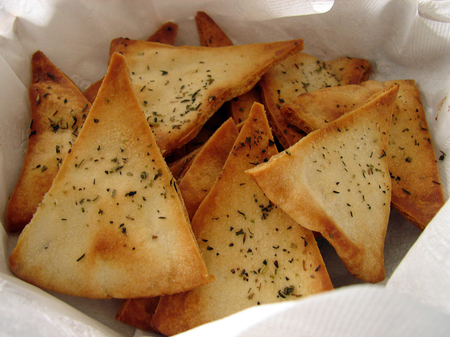
Toasted Pita Crisps

Unless you’ve been living under a rock for the last several years, you’re probably familiar with the ubiquitous Stacy’s Pita Crisps. They seem to make an appearance at virtually every party I attend alongside one dip or another. And, I’ll admit, they’re delicious! Not a bad choice health wise either, (unless of course you’re prone to eat the whole bag). Pita is usually made with white flour so it’s not the healthiest carbohydrate choice you can make,  but for a baked, crunchy snack, they still make my “keep “list. I’d say they’re quickly becoming a classic replacing potato chips and pretzels as favorite party fare.

In this case, it turns out that you can improve upon a classic. I think the recipe that follows does just that. It’s adapted slightly from Giada DeLaurentiis’ version and it’s simply delicious.  The garlic and oregano flavors take these dippers up a notch and breathe some new life into your appetizer hour. Try them this weekend with your favorite hummus  (or Giada’s white bean dip)  –  rest assured that your house will smell AMAZING and your family or guests will help you avoid eating the entire batch by yourself!


Toasted Pita Crisps

Makes 48 crisps

Ingredients:

6 garlic-oregano pita bread rounds (I like Old World brand)

2 Tbsp. olive oil

1 tsp. kosher salt

1/2 tsp. freshly ground black pepper

Directions:

Preheat oven to 400. Brush pitas with olive oil and sprinkle with salt and pepper. Cut each pita into 8 triangles. Spread pieces evenly on a heavy-gauge cookie sheet. Bake 8 minutes. Flip triangles and bake 8 more minutes. Remove from oven, cool and eat.

Whose goal is it, anyway?

This weekend as I was clearing out a drawer, I unearthed a treasure. It was a handwritten list of my life’s goals, circa 1998. When I found it, I stopped what I was doing, sat down in the middle of the room, and took a look at what I’d written. Reading the list took me on  a trip down memory lane. Both the things I’d chosen to put on this list and those I’d been afraid to put on said a lot about me at that time in my life. I’d tracked my progress with checkmarks and dates off and on over the years, but I’d lost track of this particular piece of paper for a while. That’s not to say I’d stopped pursuing the goals. In fact, I’d achieved quite a number of them since the last updating, and found myself reaching for a pencil to add a few checkmarks and dates to the page. In other instances, I wondered aloud what I’d been thinking when I’d set that ridiculous objective, and began instinctively editing the list.

In full disclosure, I’m a serial goal-setter with  handwritten and computerized lists, short-term and long-term lists, lists categorized by aspects of my life. I keep them current, adjusting them as circumstances change, or as I change. But this list, having been lost, provided a clear snapshot of a particular point in time. To  reflect the goals I hold foremost in mind today, it would need to be dusted off, edited, shaped. In fact, it’s that pruning process that I believe is central to good goal setting.

Goals are powerful tools to direct our behavior, so before we put our heart and soul into achieving them, it’s important that we ensure the goals are our OWN. That may seem obvious, but sometimes goals creep in that aren’t ours at all. There are those our parents set for us years ago, or that an ex-boyfriend casually suggested, or that our spouse thinks we should pursue. Over time, we adopt these goals which have been thrust upon us (perhaps even gently bestowed upon us) as our own and we fervently chase them. And chase them. And chase them.

It’s especially hard to achieve a goal that is not your own. The pursuit lacks passion and vigor. Your heart isn’t in it. But a goal you set for yourself? One that lines up with your interests, your beliefs, your dreams? Give you one of those and I’ll bet you’re practically unstoppable.

So, the question is, are you setting and pursuing goals? And if so, are you achieving them?

If not, it may be time to ask yourself, whose goals are they anyway? If you find that a goal you are chasing is not your own, simply get out your pencil and do a little editing. Revise it, tweak it, overhaul it completely if you must. But make sure the final version is your own. When you own the goal, you’ll own the result, and nothing will be able to stop you. Not even if the list itself is hidden away in a desk drawer for years at a time. The goal will live in YOU.

Are you full yet?

We’re born with the capability to recognize when we’ve eaten enough. My 8-month-old can do it. When she’s hungry, she eats. When she’s full, she purses her little lips and turns her head in every direction she can to evade my spoon. She practically climbs out of her high chair to avoid taking one bite beyond what her body is telling her it wants. She knows when she is full with no training, no self-help books, and no health coach to tell her.

Yet, as we grow older, we often turn off this God-given capability. We think we’re smarter than our body, and so we over-ride our body’s signals with new signals from our brains. Here’s the issue. These brain signals aren’t always helpful. They’re the ones that say “Oooh. Yes! Dessert! I absolutely must have that dessert” 90 seconds  after we’ve finished a full meal.  These brain signals are the ones that urge us to finish the restaurant meal because we paid for it or to accept the snack offered by our host in order to be gracious. They beg for popcorn at the movies because we smell it and M&Ms in the checkout line because we see them and ice cream at the beach because we’re hot. Our brains are making us fat.

To break this cycle, we need to remove our brains from power and put our bodies back in charge. Our bodies understand satiety. They understand when we are truly hungry and when we’ve had enough. Our bodies don’t worry about what we smell or what we see or what we’ve paid for…and when it comes to our health, neither should we.

Learning to listen to your body feels like coming home to yourself. Somewhere in the recesses of your brain you remember what it was like when your body was in charge. You can remember how you felt good ALL the time because you were never starving but never stuffed either. You can feel that way again.

Put your body back in charge. Let your belly (and only your belly) decide when it’s time to eat and when it’s time to stop. It will take some time in trial and error to fully over-ride the strong signals coming from  your brain. But when you do, you’ll be just like my baby, pursing your lips and pushing away your spoon when your belly tells you it’s full as if it were child’s play.  No training, self help book or health coach required.